12 Reasons Why to Change Insulation - XPS vs EPS
Many myths about rigid insulation have been spread over the years, especially concerning EPS. Some of these EPS myths refer back to an extinct product called bead board. Modern day Engineered EPS is so different and technologically advanced, it’s amazing some still get confused. EPS have made major advancements in chemistry, fusion, expansion, steam quality and TQM. Plymouth Foam, the leader in foam, has state-of-the-art proprietary manufacturing technology to make the product even better.

Lab and field research have lead to new conclusions about the two rigid insulations especially in below grade applications. EPS rigid insulation is certainly been found to be superior to XPS in so many ways. The following is just 12 reasons why.
1) Higher R-Value Retention:
EPS does not suffer from the same plight as XPS in regards to “Off Gassing.” XPS has blowing agents that initially give it a higher R-value, but these gasses escape over time, lowering the R-value.
2) Durability
Engineered EPS can be made in various densities and can achieve compressive strength up to 8,640 lbs/ft and flexural strength up to 10,800 lbs/ft. It is amazing that such a light product, that is 98% air, is so strong.
3) Moisture Management
EPS insulation is non-hygroscopic and does not readily absorb moisture from the atmosphere. Its closed-cell structure reduces the absorption of moisture into the insulation material yet it can readily expel any absorbed moisture.
4) 100% R-Value Warranty
Due to the R-value stability of EPS, Plymouth Foam offers a lifetime limited 100% R-Value Warranty. XPS offers a 90% R-value warranty.
5) No Harmful Chemicals
EPS does not have VOCs or other harmful chemicals in its product. XPS use of chemical HFCs has been deemed to have a high GWP.
6) Cost Advantage
R-value cost per inch is far less in EPS insulation vs XPS Insulation. Value engineering can be used to save $1,000s on projects.
7) Superior Bonding
Due to the manufacturing process, EPS and XPS provide a far different exterior surface. EPS cell structure provides superior bonding.
8) Made in USA - Made in Wisconsin
Plymouth Foam’s EPS is made in Wisconsin and brings jobs, reduces taxes and helps create a better economy for our state. Made in USA.
9) Customizable
Engineered EPS is superior in customizing thickness, lengths, shapes, tapers, chases and can even have reflective laminates attached.
10) Smoke Development
ASTM E84 test method for burning characteristic show that typically EPS has a lower smoke development than XPS.
11) Lower GWP
EPS, the safe insulation, has a lower Global Warming Potential than XPS. Transportation costs are usually lower also lowering GWP.
12) Recycle Accessibility
With over 200 EPS recycling centers in the United States it is easy to see that not only is it 100% recyclable, but it easy to do.
(Learn More about these 12 reasons)
As EPS continues to grow even more popular and gain market share, competitors have continued to spread these old myths. The bad news for them is these myths have been BUSTED. Numerous studies done around the world are proving that EPS is not only “the safe insulation” but that it holds its R-value better, is extremely durable, great in freeze-thaw cycling, has great drying potential and outperforms all other rigid foam insulations.
(Get the 12 Reasons Brochure)
What Insulation is the Best in Roofing?
- R-Value
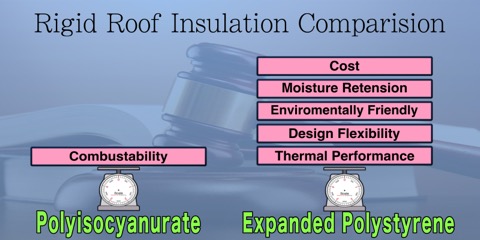
R-value is more than the R-value per inch. Polyisocyanurate (ISO), starts out with a higher r-value per inch, but then the blowing agents escapes and the R-value is reduced. (learn more) Expanded Polystyrene (EPS) has a lower R-value per inch but can be make thicker to match any R-value requirement. EPS’s R-value increase in colder temperature while ISO decreases. Many would give ISO the edge because of R/inch, but taking into consideration overpaying for R-value that does not stay stable in lower temperature, the advantage has to good to EPS.
- Environmentally Friendly
- Combustion
- Cost
- Design Flexibility
- Moisture Retention
Expanded Polystyrene, when compared to polyisocyanurate, certainly has more reason to be use in roofing. It seems over the last few years, many designer have lost sight of the purpose of insulation and the importance of R-value long-term. Some designer only considered combustibility and its superior importance, when in all likely hood this physical property will never ever be used. A feature such as long-term R-value, which performs daily in that system, or even moisture expelling capability, get lower considerations. When all of the major features of insulation are considered, EPS seems to be the clear winner.